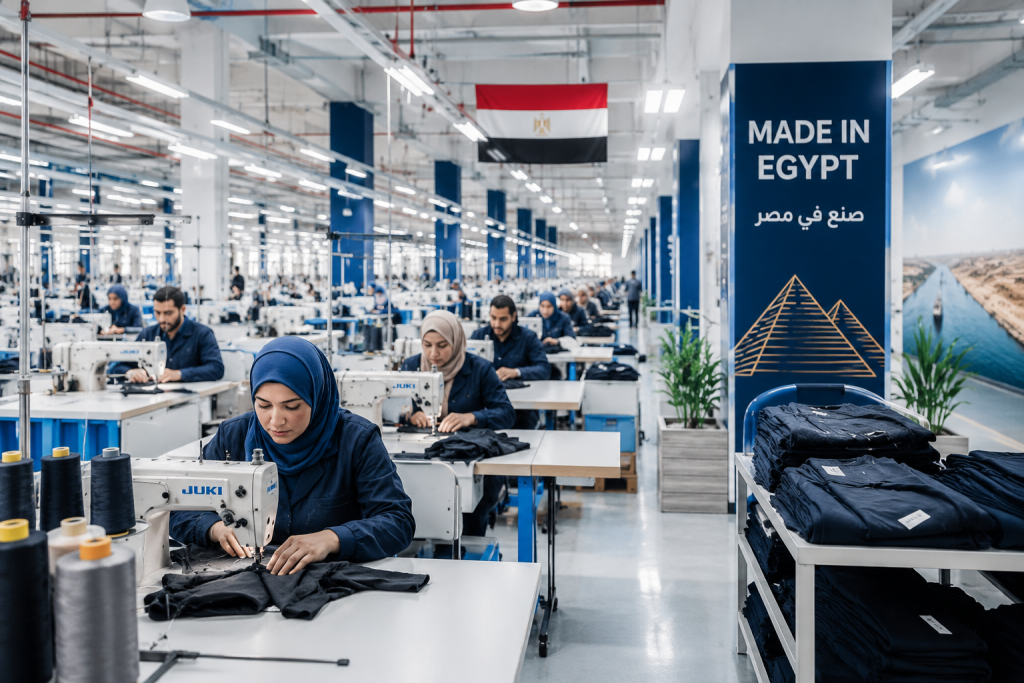
Over the past few weeks, I’ve had the opportunity to travel across Egypt and speak with people involved in its apparel and textile sector. My journey will conclude with a few days in Cairo next week, and one message has come through consistently:
Egypt is attracting far more serious interest from international manufacturers than many people outside the region realise.
Curious to understand whether this was simply local optimism or a genuine shift, I looked beyond the conversations and examined recent investment announcements, trade agreements and industry data.
The conclusion?
Egypt is not about to replace China, Vietnam or Bangladesh as a global sourcing powerhouse. However, it is becoming an increasingly compelling manufacturing location for international apparel and textile companies looking to diversify their supply chains and improve access to key export markets.
Investment is no longer just talk
One of the strongest indicators of confidence is the growing number of international manufacturers either expanding in Egypt or announcing new investments.
Recent announcements from Egypt’s General Authority for Investment and Free Zones (GAFI) and the Suez Canal Economic Zone (SCZone) highlight significant commitments from Turkish and Asian textile groups.
Turkish manufacturer Jade Textile has continued expanding its Egyptian operations, while Eroğlu Global Holding recently inaugurated a new garment manufacturing facility in the Qantara West Industrial Zone. South Korea’s Samil Solution has also committed to establishing a garment factory there, and Hong Kong-based Fountain Set has announced plans to explore a major integrated textile investment.
It is equally important to distinguish confirmed investments from proposed ones. For example, Crystal Martin has publicly announced that it is evaluating opportunities in Egypt, but this remains a proposed investment rather than an operational manufacturing facility.
Taken together, these announcements suggest that Egypt is increasingly appearing on the investment radar of international manufacturers.
Market access is a major competitive advantage
One of Egypt’s greatest strengths is not simply its manufacturing capability – it’s where manufacturers can sell the products they make.
Through the Qualifying Industrial Zones (QIZ) programme, qualifying garments manufactured in designated Egyptian zones can enter the United States duty-free, provided the programme’s rules are met.
At the same time, Egypt enjoys preferential trade arrangements with Europe, many Arab nations and numerous African countries.
For manufacturers serving multiple export markets, that combination can represent a significant commercial advantage.
According to information published by the American Chamber of Commerce in Egypt, more than 1,200 companies now participate in the QIZ programme, with apparel businesses accounting for the overwhelming majority.
Geography matters more than ever
Supply chain decisions today are no longer driven solely by the lowest manufacturing cost.
Lead times, freight risk, inventory exposure and the ability to replenish quickly have become increasingly important.
Egypt occupies a strategically attractive position at the crossroads of Europe, Africa and the Middle East, with the Suez Canal providing access to one of the world’s most important shipping corridors.
For European brands especially, manufacturing in Egypt has the potential to shorten supply chains and improve responsiveness compared with many Asian sourcing locations.
The exact savings naturally depend on customer location, shipping routes and product type, but the geographical advantage is undeniable.
Diversification is becoming a strategic priority
Over the past five years, global sourcing strategies have changed significantly.
Pandemic disruption, freight volatility, geopolitical uncertainty and changing trade policies have encouraged many brands to reduce dependence on a single sourcing country.
Rather than replacing established manufacturing bases, companies are increasingly building broader regional sourcing portfolios.
Egypt fits naturally into that strategy.
Research published by the Egyptian Center for Economic Studies (ECES) suggests that Egypt has benefited from buyers seeking alternatives to traditional sourcing markets, particularly for exports to the United States.
While Egypt remains relatively small compared with the world’s largest apparel exporters, its trajectory appears encouraging.
Egypt already has a strong manufacturing foundation
Unlike some emerging manufacturing destinations, Egypt is not starting from scratch.
The country has decades of textile manufacturing experience, an established industrial base and capabilities across spinning, weaving, knitting, dyeing, finishing and garment production.
Government-led investment programmes are also modernising parts of the textile industry, with significant investment in spinning and weaving facilities intended to improve productivity and competitiveness.
The opportunity therefore extends beyond low-cost manufacturing.
It lies in developing a more integrated textile supply chain capable of serving international brands with increasing speed, quality and consistency.
Industrial clusters are beginning to take shape
The development of the Qantara West Industrial Zone is particularly interesting.
Rather than attracting isolated factories, Egypt appears to be building manufacturing clusters where garment factories, textile producers, suppliers and logistics providers can benefit from shared infrastructure and proximity to export routes.
If these clusters continue to develop, they could become an important competitive advantage over time.
Challenges remain
None of this suggests that manufacturing in Egypt is without challenges.
Companies must still consider:
- availability of experienced management and technical talent
- productivity and quality consistency
- dependence on imported raw materials for certain product categories
- currency volatility
- customs procedures
- environmental compliance
- continued development of local supplier networks.
Success will depend less on labour costs alone and more on operational excellence, investment in people and strong management capability.
What does this mean for our industry?
As someone who specialises in executive search within the global apparel, textile and manufacturing supply chain, I see another trend developing alongside the investment announcements.
As international companies establish or expand operations in Egypt, demand for experienced leadership talent is increasing just as quickly as demand for new factories.
Modern manufacturing facilities require far more than machinery and buildings. Success depends on experienced leaders who can build high-performing teams, implement world-class manufacturing systems, drive operational excellence and create the culture needed to meet the expectations of international brands.
The greatest opportunities are likely to be for senior professionals across manufacturing, operations, technical services, product development, sourcing, quality, industrial engineering and supply chain leadership. Individuals who have successfully built or transformed operations in established manufacturing hubs such as Bangladesh, Vietnam, China, Sri Lanka, India and Türkiye will bring highly transferable experience.
This mirrors what we have seen in many emerging manufacturing markets over the past two decades. Capital investment can create factories quickly; developing capable leadership teams takes considerably longer.
For companies investing in Egypt, attracting and retaining experienced leaders may become one of the most important competitive advantages over the next five to ten years.
For professionals with the right international experience, Egypt represents an increasingly attractive opportunity to help shape the next phase of the country’s manufacturing development.
A country worth watching
Egypt is not the next China.
Nor should it aspire to be.
Instead, it is carving out its own position as a strategically located manufacturing hub with improving market access, growing international investment and an increasingly attractive value proposition.
Whether that potential is fully realised will depend on continued investment, operational excellence and the ability to develop world-class manufacturing capability.
Based on what I’ve seen and the evidence I’ve reviewed, Egypt deserves to be taken seriously by anyone involved in global apparel and textile sourcing.
Sources
This article draws on publicly available information published by the General Authority for Investment and Free Zones (GAFI), the Suez Canal Economic Zone (SCZone), the American Chamber of Commerce in Egypt, the U.S. International Trade Administration, the Egyptian Center for Economic Studies (ECES), Egypt State Information Service (SIS), together with publicly announced investment announcements from international textile and apparel manufacturers.